


How to Avoid Flimsy Home Gym Equipment
Table of Contents
- Why Flimsy Home Gym Equipment Fails (and What It Costs You)
- Steel Gauge for Home Gym Equipment: The Numbers That Matter
- Signs of Poor Quality Fitness Equipment to Check Before You Buy
- How to Build a Home Gym on Budget Without Sacrificing Structural Integrity
- Used Equipment Inspection Checklist: What to Look For
- Assembly Integrity: Why Setup Mistakes Cause Wobble and Failure
- Frequently Asked Questions
Last Updated: September 10, 2026
Why Flimsy Home Gym Equipment Fails (and What It Costs You)
Cheap home gym equipment fails because it was never engineered for repeated heavy loading. Thin frames flex under dynamic load, welds crack at stress points, and bolt hardware loosens until a squat rack that felt solid on day one wobbles under a working set. Learning how to avoid flimsy home gym equipment starts with understanding that the failure is structural, not cosmetic.
The cost isn't just the replacement price. A rack that shifts mid-rep turns a heavy squat into a safety problem, and a bench that rocks under a loaded bar removes your ability to push close to failure with confidence. This guide from Perfected Health Co. breaks down the specifications that separate commercial-grade steel from catalog filler: steel gauge, weight capacity, welding quality, and assembly integrity.

Most buyers shop by photo and price. That's the mistake. Below, we'll show you exactly how to read a spec sheet before you spend a dollar.
Steel Gauge for Home Gym Equipment: The Numbers That Matter
Steel gauge for home gym equipment determines how much a frame flexes under load. Lower gauge numbers mean thicker steel, and thickness is what resists bending, vibration, and fatigue over thousands of reps (engineeringtoolbox.com).
| Component | Minimum Gauge | Why It Matters |
|---|---|---|
| Power rack uprights | 11-12 gauge | Resists flex under dynamic load |
| Squat stand frame | 12-14 gauge | Handles racked and dropped weight |
| Bench frame | 11-13 gauge | Prevents rocking under a loaded bar |
| Pull-up bar | 11 gauge | Stops bending at the mount |
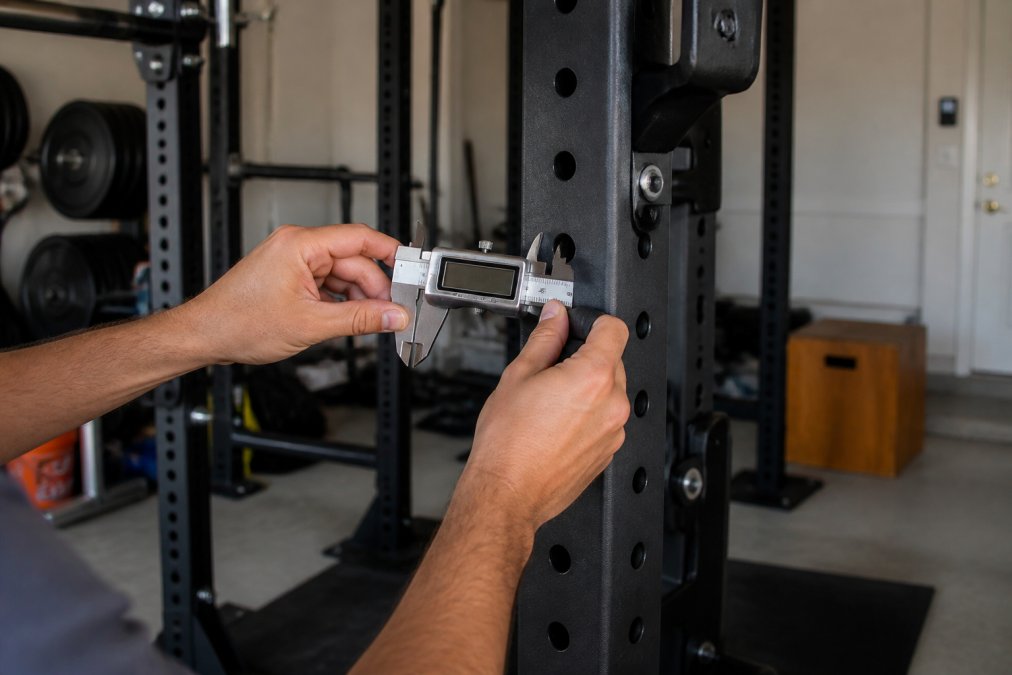
Frame thickness alone isn't enough. Tube dimensions, base width, and tensile strength all shape structural integrity. A 2x2-inch upright at 12 gauge outperforms a 2x3-inch tube at 14 gauge in most home setups because the wall thickness carries the load. Check the load-bearing rating against your heaviest projected lift, then add margin.

Signs of Poor Quality Fitness Equipment to Check Before You Buy
Signs of poor quality fitness equipment show up in the details long before anything breaks. The biggest tell is vague specifications. If a listing won't state steel gauge, weight capacity, or bolt grade, assume the worst.
- No stated gauge or capacity: Legitimate commercial equipment publishes both.
- Thin powder coating that chips at edges: Exposes bare steel to corrosion.
- Sloppy welding quality: Look for spatter, undercut, or inconsistent beads at joints.
- Cheap bolt hardware: Soft bolts stretch and loosen, causing wobble.
- Narrow base width: A rack that's tall and narrow tips under lateral force.
- Knurling that's shallow or uneven: Wears smooth and loses grip on the bar.
What most guides miss is that corrosion resistance and upholstery durability are early warning signs. If the powder coating is thin on the frame, it's thin everywhere, including the joints that matter most.
How to Build a Home Gym on Budget Without Sacrificing Structural Integrity
A budget home gym only fails when money is spent on the wrong parts. The trick is to understand where load actually travels, then overbuild that path and economize everywhere else. Steel, welds, and hardware carry the weight. Flooring, upholstery, and accessories do not.
Start by mapping the load path for each movement you plan to do. In a squat, force travels from the bar into the J-hooks, down the uprights, through the base, and into the floor. In a bench press, it travels from the bar into the uprights and the bench frame, then into the floor. Anything in that path needs to be overbuilt. Anything outside it, collars, bands, cable attachments, a foam roller, can be cheap without consequence.
Where to spend:
- Uprights and base. This is the load-bearing skeleton. Look for 11- to 12-gauge steel on uprights and a base wide enough that a side push doesn't tip the unit. A 2x2-inch upright at 12 gauge generally resists flex better than a 2x3-inch tube at 14 gauge because wall thickness, not tube width, carries the bending load.
- Welds at the joints. The upright-to-base and upright-to-crossmember welds see the highest stress. A clean, consistent bead with no undercut or spatter is a stronger signal of build quality than any marketing claim.
- Bolt hardware. Grade 5 or Grade 8 bolts with matching washers and lock nuts hold torque under vibration (fastenal.com). Soft, ungraded hardware stretches and loosens, which is the most common source of "wobbly rack" complaints that get blamed on the frame.
- J-hooks and safeties. These take the bar directly. Plastic-lined steel hooks with a full weld to the upright outperform bolt-on hooks that can shift under a missed rep.
Where to save:
- Flooring. Interlocking rubber tiles or 3/4-inch horse-stall mats protect concrete and damp vibration. They do not need to be premium to do that job.
- Accessories. Bands, collars, chalk, and cable attachments can be added over time. None of them affect structural safety.
- Upholstery on benches. A bench pad is a wear item. A firm, high-density pad matters more than a brand name; a soft pad compresses and changes your pressing angle over time.
- Selectorized vs. plate-loaded. Plate-loaded machines have fewer moving parts, fewer cables, and fewer failure points. For a tight budget, that trade-off usually favors plate-loaded.
A useful rule of thumb: if a spec sheet won't state steel gauge, weight capacity, and bolt grade, treat the piece as unrated. Legitimate commercial-grade equipment publishes all three because buyers who lift heavy ask for them.

Used Equipment Inspection Checklist: What to Look For
A used rack or bench can be a bargain or a liability, and the difference is almost never visible in a listing photo. The inspection below is built around the same structural criteria a buyer would use on new equipment: steel gauge, weld integrity, hardware grade, and base geometry. Run it in person, in good light, before any money changes hands.
Bring these tools: a magnetic steel gauge or digital calipers, a torpedo level, a flashlight, a 3/8-inch or 1/2-inch wrench that matches common rack hardware, and a rag to wipe away grime that hides rust.
Steel and frame
- Measure upright wall thickness with calipers or a magnetic gauge. If the seller won't let you measure, that's a signal. Uprights below 14 gauge on a rack rated for heavy squats should be treated as suspect.
- Check tube dimensions against the stated spec. A 2x2-inch upright at 12 gauge is a different animal than a 2x3-inch tube at 14 gauge, wall thickness carries the load.
- Look for bends, kinks, or a frame that won't sit flat on a level floor. A rack that's out of square will never sit flat no matter how you tighten the bolts.
- Inspect the base width. A tall, narrow rack tips under lateral force; a wide base with crossmembers resists it.
Welds
- Examine every weld at the upright-to-base and upright-to-crossmember joints. Look for cracks, undercut, porosity, or spatter, all signs of a weak or rushed bead.
- Check for repair marks: grinding, paint over a weld, or a bead that looks different from the others. A repaired weld on a load-bearing joint is a red flag.
- Look for rust bleed at the weld toes. Rust often starts inside a tube joint where you can't see it in daylight, so use the flashlight.
Hardware and fasteners
- Inspect bolt heads for rounded corners or stripped threads. Soft, ungraded hardware stretches and loosens under vibration.
- Confirm bolts are Grade 5 or Grade 8 where the manufacturer specifies them. Mismatched or missing washers and lock nuts are a sign of a partial or sloppy reassembly.
- Ask for the original assembly instructions and hardware. Missing hardware is a common reason a used rack is being sold.
Moving parts and accessories
- Test adjustable dumbbells and selectorized pins for smooth travel. Sticking pins usually mean bent rods or worn bushings.
- Spin barbell sleeves and weight horns. Seized sleeves mean rust or a bent shaft.
- Stack plates and check for rattle. Excessive rattle suggests out-of-tolerance plates or a bent sleeve.
- Check cable tension and inspect cables for fraying, kinks, or exposed core. A frayed cable is a replacement, not a negotiation point.
Bench and upholstery
- Press the pad with your palm. A pad that bottoms out or stays compressed is worn and will change your pressing angle.
- Check the frame under the pad for cracks at the hinge and at the upright joint.
- Rock the bench on a level floor. Any wobble that isn't fixed by tightening hardware means a bent frame.
How to decide
A used piece is worth buying when the frame is straight, the welds are clean, and the hardware is grade-correct. It's a liability when any load-bearing weld is cracked or repaired, when the frame is bent or out of square, or when the seller can't or won't let you measure steel thickness. In those cases, the savings rarely cover the cost of making the piece safe.
Assembly Integrity: Why Setup Mistakes Cause Wobble and Failure
Assembly integrity is the most overlooked cause of wobble. A perfectly good rack bolted together with hand-tight hardware or missing washers will flex and shift, and the frame gets blamed for a setup error.
Follow the assembly instructions in order, and don't fully tighten any bolt until the whole frame is square. Use a level on the base, torque the load-bearing bolts last, and re-check everything after the first week of use. Vibration dampening from rubber mats helps, but it won't fix a rack that was never squared.
Frequently Asked Questions
What are the red flags of low-quality home gym equipment?
Watch for steel thinner than 11 gauge on load-bearing frames, visible weld porosity or spatter, powder coating that chips easily, and hardware that strips during assembly. A rack that wobbles when you rack a loaded bar or has base tubes under 2 inches is a clear sign of flimsy home gym construction.
Does steel gauge thickness matter for home gym equipment?
Yes. Steel gauge for home gym equipment directly determines load-bearing capacity and long-term stability. An 11-gauge frame handles heavy squat and bench loads with minimal flex, while 14-gauge or thinner steel flexes under dynamic load and eventually fatigues at the welds. Commercial-grade racks typically use 11-gauge or 7-gauge steel. If a manufacturer does not publish the gauge, assume it is too thin for serious lifting.
How can you tell if a squat rack is stable enough for heavy lifting?
Check base width, steel gauge, and bolt hardware first. A stable rack has a base at least 48 inches wide, uses 11-gauge or thicker steel, and includes grade 8 bolts with locking washers. Grab the uprights and push side to side; any visible wobble means the frame is too thin or the assembly is loose. Safety pins and J-hooks should engage the uprights with zero play under load.
How do you inspect used gym equipment before buying?
Run through this checklist: inspect every weld for cracks or rust, test adjustable dumbbells for seized sleeves, check cable tension on functional trainers, look for corrosion resistance issues under powder coating, and verify all bolt hardware is present and not stripped. Ask the seller to assemble it so you can test stability under load. Missing assembly instructions and non-standard hardware are deal-breakers.
Flimsy equipment is a false economy. It costs you a second purchase, and it costs you the confidence to train heavy at home. Perfected Health Co. stocks durable, thoughtfully engineered strength and recovery equipment, including commercial squat racks, all-in-one Smith machine systems, and adjustable benches, with free shipping on most orders and a 30-day return policy. See the full setup and build a training space that holds up.