


How to Fit a Smith Machine in a Small Garage
Table of Contents
- Measure Your Garage Before You Buy
- The Minimum Space for Smith Machine Setup
- Check Your Floor and Learn How to Anchor Gym Equipment to Concrete
- Garage Gym Layout Ideas That Maximize Usable Space
- Plan for Lighting, Power, and Safety Zones
- Assembly Tips for Tight Spaces
- Common Mistakes to Avoid
- Final Checklist for Your Small Garage Smith Machine
- Frequently Asked Questions
Last Updated: September 7, 2026
Fitting a Smith machine into a small garage is less about brute force and more about precise measurement, honest assessment of your space, and a clear-eyed plan for the layout, but the key is to fit Smith machine dimensions into your available square footage before you commit. Most people fail because they bought a machine before they measured their ceiling, floor slope, or available square footage.
A Smith machine is a barbell fixed within vertical steel guide rods, allowing for controlled, guided lifts without a spotter. This guided design demands precise installation: the frame must be perfectly level, the rails must align, and you need enough room to load plates and move freely around the bar path.
Measure Your Garage Before You Buy
The first and most critical rule is to measure everything before you commit to a purchase. Record three numbers: the floor footprint where you plan to place the machine, the ceiling height directly above that spot, and the diagonal clearance from the top of the machine to any obstructions like garage door tracks or rafters.
Key Dimensions: Footprint, Ceiling, and Clearance
A Smith machine footprint typically runs 4 to 5 feet deep and 4 to 7 feet wide, but the number that surprises most people is the ceiling height requirement, which is why you must measure to fit Smith machine clearance above the bar path. You need enough vertical clearance for the bar to travel its full range plus your own standing height, which means most standard 8-foot garage ceilings are workable, but 7-foot ceilings often are not. Here is the precise math you need to run:
- Measure the machine's maximum bar height. Most full-size Smith machines have a top bar position between 6.5 and 7.5 feet off the floor when the carriage is at its highest point. Check the manufacturer's spec sheet for the exact number.
- Add your own height plus overhead press clearance. If you are 6 feet tall and pressing overhead, you need roughly 2 feet of space above your head to lock out safely. That puts your absolute minimum ceiling height at 8 feet for a standard machine.
- Account for garage door tracks and openers. The ceiling height at the wall is rarely the problem; the issue is the garage door track that runs parallel to the ceiling and drops down 12 to 18 inches. If your machine's bar path falls under that track, you lose that clearance. Measure the distance from the floor to the lowest point of the track, not just the ceiling itself.
- Check the ceiling slope. Many garages have a pitched floor for drainage, so measure at the exact spot, not just along the wall. A 1/4-inch-per-foot slope across a 4-foot footprint means a 1-inch difference between the front and back feet of the machine. That is enough to cause the carriage to bind on the rails.
If your garage has a garage door opener, a storage rack, or hanging shelves, confirm that the bar path and your head clearance won't collide with them during a lift. A common pattern is to mount the machine offset from the garage door track so the bar path sits in the open bay rather than directly under the track. If you have a low ceiling, consider a compact or half-rack Smith machine variant that reduces the top bar height by 6 to 12 inches, or a wall-mounted unit that uses a shorter guide rail system.
The Minimum Space for Smith Machine Setup
The minimum space for smith machine setup is larger than the footprint of the unit itself. You need the machine's dimensions plus a safety zone on every side where you can load plates, step into position, and bail out of a failed rep without hitting a wall or stored items. Add at least two to three feet of clearance on the loading sides and a foot behind the machine, meaning a 4-foot by 7-foot footprint realistically needs a dedicated zone closer to 7 feet by 10 feet.
Without this safety zone, you will awkwardly angle plates onto the bar, bump your elbows on shelves, and create a hazard when reracking. If your garage cannot spare the full zone, consider a wall-mounted or folding Smith machine variant, or shift shelving to a different wall.
Check Your Floor and Learn How to Anchor Gym Equipment to Concrete
Garage floors are rarely perfectly level, and a Smith machine demands a level base for the guide rods to function smoothly. Before assembly, use a 4-foot or longer level to check the floor slope in both directions across your intended footprint. If you find a slope of more than 1/8 inch over a 4-foot span, use steel or composite leveling shims under the base plates; ignoring this causes the carriage to bind on the rails. Do not use wood shims, as they compress over time.
Floor Protection and Load-Bearing Considerations
A Smith machine with a loaded barbell can easily exceed 400 to 600 pounds, and that weight is concentrated on four small base feet. A standard 4-inch-thick concrete garage slab is typically rated to handle that load, but there are two situations where you need to think about reinforcement:
- Cracked or older concrete. If your slab has visible cracks, spalling, or a history of settling, the concentrated point loads from the machine's feet can worsen the damage. Place a 3/4-inch thick rubber stall mat under the entire footprint to distribute the load across a wider area. Do not use thin puzzle mats or rolled rubber underlayment; they do not provide enough compression resistance.
- Expansion joints. If your planned footprint crosses an expansion joint in the concrete, the two sides of the slab can move independently by a fraction of an inch. That movement will translate directly to the machine frame and cause the guide rods to bind. Shift the machine so all four feet sit on the same side of the joint, or bridge the joint with a 1/2-inch steel plate under the base feet.
For the mat itself, look for a 3/4-inch thick, 4-foot by 6-foot rubber stall mat rated for heavy equipment. These mats weigh roughly 100 pounds each and are dense enough to prevent the machine from sinking in. Do not place the mat under the machine and then bolt through it; cut the mat to fit around the base feet so the anchors bite directly into the concrete.
How to Anchor Gym Equipment to Concrete
Once the machine is level, you must learn how to anchor gym equipment to concrete. A Smith machine holding heavy loads can shift or tip if it is not bolted down, especially during re-racking or if you ever lose control of the bar. Most units come with anchor holes in the base feet; use a hammer drill with a masonry bit, insert the appropriate concrete anchors, and bolt the frame securely to the floor. Here is the process:
- Select the right anchor. For a Smith machine, use 1/2-inch or 5/8-inch wedge anchors or sleeve anchors rated for at least 1,000 pounds of pullout force (concretefasteners.com). Do not use plastic wall plugs or drywall anchors; they are not rated for this application.
- Drill the holes. Mark the anchor hole positions through the base feet, then move the machine aside. Drill with a hammer drill and a carbide-tipped masonry bit to the depth specified by the anchor manufacturer, typically 2.5 to 3 inches. Vacuum out the dust.
- Set the anchors. Insert the wedge anchor into the hole and tap it flush with the concrete surface. Tighten the nut to the manufacturer's torque spec, which is usually 40 to 50 foot-pounds for a 1/2-inch wedge anchor (hilti.com).
- Re-position and bolt down. Place the machine back over the anchors, align the base feet, and thread the bolts through the frame into the anchors. Tighten in a cross pattern to avoid pulling the frame out of level.
If you are hesitant to drill into your garage slab, a heavy rubber stall mat offers some protection, but bolting is the only way to guarantee full structural integrity under maximal loads. A mat alone does not prevent lateral movement during re-racking.
Garage Gym Layout Ideas That Maximize Usable Space
The best garage gym layout ideas treat the Smith machine as the centerpiece and arrange everything else around it. Position the machine against the back wall or a side wall to keep the center of the garage open for other movements like deadlifts, kettlebell swings, or a functional trainer. This wall placement also keeps the bar path away from foot traffic.
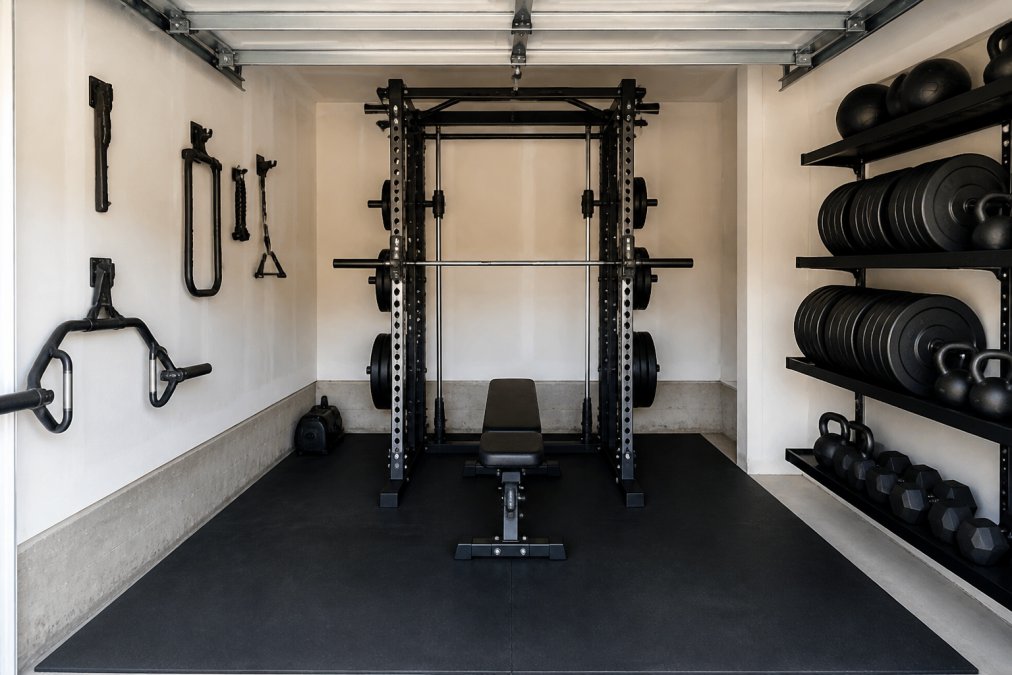
Think vertically to reclaim floor space. Install heavy-duty wall-mounted racks for bumper plates and dumbbells, use pegboards for accessory storage, and keep the area directly in front of the machine completely clear. If you park a car in the garage, measure the machine's depth against the car's length to confirm you can still close the door.
Plan for Lighting, Power, and Safety Zones
Good lighting is a non-negotiable part of a safe home gym layout. Overhead fluorescent shop lights can cast shadows directly on the bar path, making it hard to see your depth in a squat. Instead, position bright LED fixtures so they light the machine from the side or slightly behind. Also plan for power: confirm you have enough outlets on a circuit that can handle the load of any additional equipment.
Your safety zone extends beyond the machine itself. Keep a clear path from the machine to the garage door and to any electrical panel, and never store sharp tools, bikes, or clutter within the fall zone around the machine.
Assembly Tips for Tight Spaces
Assembly precision matters more in a small garage because you have no room to correct mistakes after the fact. When the machine arrives, clear the entire assembly area and lay out all parts against the wall in the order they will be installed. Do not assemble the unit in the middle of the garage and then drag it into place; position the base frame in its final location first, then build upward.
Enlist at least one strong helper for the vertical frame pieces. As you bolt the uprights to the base, check the level again after each major connection. Tighten all hardware gradually in a cross pattern to avoid binding the guide rods, and lubricate the rails according to the manufacturer's instructions before your first session. Expect the full assembly to take several hours.
Common Mistakes to Avoid
The most frequent error is underestimating the total space needed, including the safety zone and the swing of the bar. Many buyers measure only the machine's footprint and then discover they cannot load plates or rerack comfortably. A second common mistake is ignoring the floor slope and skipping the leveling step.
Another issue is poor planning for the future. If you might move homes or reconfigure your gym, choose a machine that allows for modular disassembly; keep the bolts and the original packaging so you can break the unit down for transport. Finally, do not neglect maintenance: wipe down the guide rods regularly and keep the area around the machine clear of debris.
Final Checklist for Your Small Garage Smith Machine
Before you finalize your purchase and break out the tools, run through this checklist to confirm your space is ready:
- Ceiling height: at least 7.5 to 8 feet, with no obstructions like rafters or garage door tracks above the bar path
- Floor footprint: machine dimensions plus 2 to 3 feet of clearance on loading sides
- Floor condition: relatively level, with shims ready if the slope exceeds a small fraction of an inch
- Anchoring: hammer drill, masonry bits, and concrete anchors ready to secure the frame
- Lighting: positioned to avoid shadows on the bar path
- Layout: machine against a wall, center of garage open for other movements
- Assembly: helper available, all tools on hand, assembly area cleared
Fitting a Smith machine into a small garage is entirely achievable with deliberate planning. The key is to respect the physical constraints of your space, level and anchor the machine properly, and design the layout around the machine rather than trying to squeeze it into an unplanned corner.
A cramped garage does not have to mean a cramped training experience. Perfected Health Co. offers a curated selection of durable Smith machines and garage gym accessories designed for serious lifters who demand structural integrity and thoughtful engineering. With free shipping on most orders and a 30-day return policy, you can build a professional-grade training space without the guesswork. See the full setup and start planning your garage conversion today.
Frequently Asked Questions
What is the minimum footprint required for a home Smith machine?
Most Smith machines need a footprint of roughly 4 by 7 feet, but you should add a safety zone of at least 3 feet on the sides for bar loading and a few feet in front for unracking. Measure the exact base dimensions of the model you want and compare them against your garage floor space, accounting for wall protrusions like baseboards and shelving.
How much ceiling height do I need for a Smith machine?
You need enough vertical clearance for the machine's frame plus your full range of motion during overhead presses and pull-ups. As a rule, look for at least 6 inches between the top of the frame and the ceiling. If your garage has rafters or an opener unit, measure the lowest point, since that is your true constraint.
Can a Smith machine be bolted to a concrete garage floor?
Yes, most Smith machines have pre-drilled holes in the base plates for anchoring. Use a hammer drill with a masonry bit to create pilot holes, then insert wedge anchors and tighten them with a wrench. This process stops the machine from shifting during heavy lifts and is a straightforward project for a single afternoon.
What are the best garage gym layout ideas with a Smith machine?
Position the Smith machine against the shortest wall to keep the center of the garage open for other movements. Place a stall mat under the machine and a small shelf beside it for plate storage. If you need to park a car in the same garage, measure the machine's depth and plan the layout so the car door opens without hitting the frame.