


Essential Powerlifting Home Gym Equipment
Table of Contents
- Essential Powerlifting Equipment Overview
- The Importance of a Quality Power Rack
- Choosing the Right Olympic Barbell for Home Powerlifting
- Weight Plates and Plate Storage Solutions
- Power Rack vs. Squat Stand for Powerlifting
- Support Gear: Belts, Sleeves, and Wraps
- How to Build a Powerlifting Home Gym on Budget
- Flooring, Platform Requirements, and Noise Control
- Frequently Asked Questions
Last Updated: September 18, 2026
Essential Powerlifting Equipment Overview
Building a serious powerlifting home gym with quality powerlifting home gym equipment requires a foundation designed for heavy lifting, safety, and longevity. The core difference between a functional home gym and a true powerlifting setup is load capacity and stability. A casual fitness space collapses under heavy compound movements; a powerlifting home gym is engineered to handle them.
The Importance of a Quality Power Rack
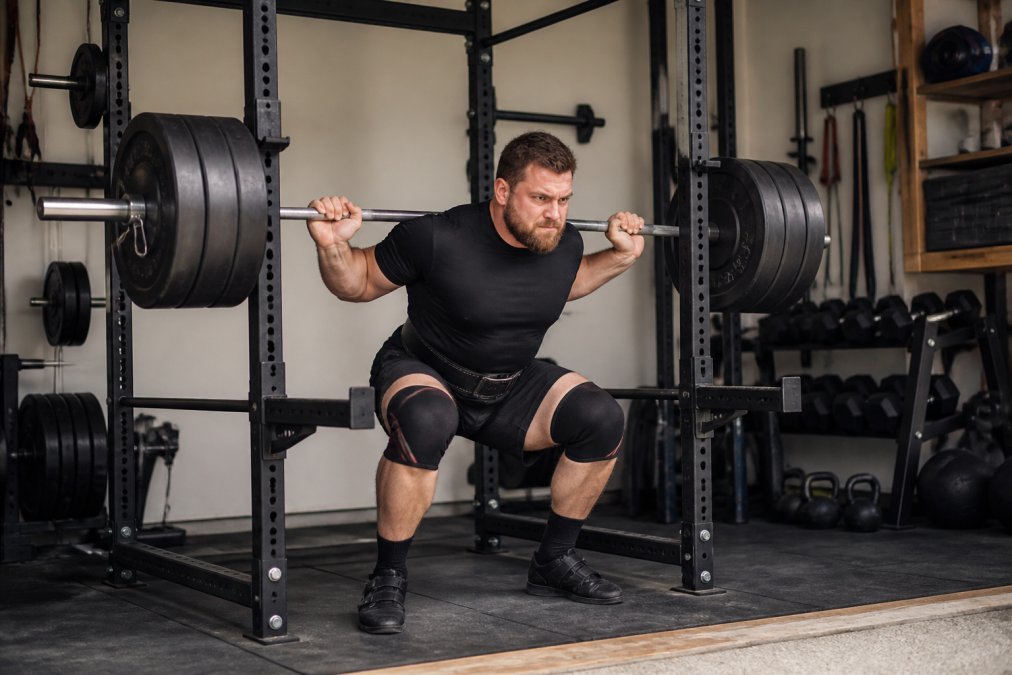
Your power rack is the centerpiece. A quality power rack like the Commercial Squat Rack w/ Safety Bars, J-Hooks & Weight Storage from Perfected Health Co. ($1,499.00) delivers safety and versatility for solo heavy lifting. Key features: adjustable J-hooks for proper bar positioning, safety catches to prevent catastrophic failure, and enough interior space for proper form and range of motion.

A common mistake is buying a squat stand instead of a full rack.
Choosing the Right Olympic Barbell for Home Powerlifting
Not all barbells are equal. Choose an Olympic barbell that handles your projected max lifts plus buffer. If you plan to squat 500 lbs, your barbell should handle 600+ lbs safely. Look for high tensile strength (190,000+ PSI) and aggressive knurling that prevents slippage during heavy pulls.
Weight Plates and Plate Storage Solutions
Iron plates are economical for heavy loading and denser than bumper plates, saving floor space. Bumper plates are essential if dropping weight from overhead or if you have neighbors below you, as the rubber coating absorbs impact and reduces noise.
| Plate Type | Best For | Durability | Cost |
|---|---|---|---|
| Iron plates | Heavy loading, space efficiency | Excellent (decades) | Budget-friendly |
| Bumper plates | Dropping weight, noise reduction | Good (5-10 years) | Higher cost |
| Calibrated competition plates | Precision training, competition prep | Excellent | Premium pricing |
Power Rack vs. Squat Stand for Powerlifting
This decision determines your training ceiling.
A squat stand is two vertical posts with safety arms; a power rack is a four-post structure with multiple attachment points. Squat stands work for conservative squats but fail for bench press, rack pulls, and accessory movements. A power rack's four-post design provides stability that stands can't match, especially during heavy singles. For solo training without a spotter, that stability is essential.
Support Gear: Belts, Sleeves, and Wraps
Support gear enables progression: a weightlifting belt increases intra-abdominal pressure for harder bracing, knee sleeves reduce joint stress during high-volume leg training, and wrist wraps stabilize the wrist during pressing. For powerlifting, they're essential. A quality leather belt ($50-100) lasts years, budget neoprene sleeves ($30-60) work for home training, and wrist wraps ($15-30) provide immediate feedback. Buy quality versions; cheap gear doesn't deliver results.
How to Build a Powerlifting Home Gym on Budget
You don't need $10,000 to start. Navigate the used equipment market, where most serious lifters find their best deals.
The Budget Hierarchy: What to Buy New vs. Used
Buy New:
- Power rack: Structural integrity is difficult to assess without engineering knowledge. New racks from reputable manufacturers come with warranties and verified load ratings ($800-1,500).
- Barbell: A bent or damaged barbell affects form and safety. New Olympic barbells cost $100-250 and last decades.
- Bench: A wobbly or cracked bench undermines pressing form. New adjustable benches run $200-400.
Buy Used (With Inspection):
- Weight plates: Iron plates are nearly indestructible. Inspect for cracks, deep gouges, or rust that prevents loading. Used plates cost 30-50% less than new. A used 45 lb plate might cost $0.50-0.75 per pound versus $1.00-1.50 new.
- Dumbbells: Check for cracked heads or bent handles. Otherwise, they're solid purchases secondhand.
- Accessories: Belts, sleeves, wraps, and straps rarely wear out. Buy used without hesitation.
How to Inspect Used Powerlifting Equipment
Power Rack Inspection Checklist:
- Uprights: Sight down each post for bends or twists; a bent upright will wobble and fail catastrophically.
- Welds: Check for hairline cracks or heat discoloration; walk away if found.
- J-hooks and safety bars: Ensure smooth movement and firm locking; stripped threads won't hold position.
- Footprint: Verify it matches your space (48-inch-wide is standard).
- Load rating: Request documentation; if unavailable, assume the rating is lower than claimed.
Barbell Inspection Checklist:
All-in-One Home Gym, Power Rack w →
- Straightness: Roll on a flat surface; any wobble indicates a bend.
- Knurling: Check for wear; aggressive knurling is preferable and can't be restored.
- Sleeves: Spin smoothly; stiff sleeves indicate rust or bearing damage.
- Center knurl: For squat bars, intact center knurl is essential for shoulder stability.
- Markings: Legitimate Olympic barbells have depth markings at 81 cm from center; unmarked bars are often cheap imports.
Plate Inspection Checklist:
- Cracks: Look for cracks, especially around the center hole; cracked plates shatter under load.
- Rust: Deep pitting or flaking indicates structural damage; surface rust is cosmetic.
- Weight consistency: Variation of more than 1 lb between same-denomination plates indicates poor manufacturing or damage.
- Bumper plate condition: Check for missing rubber chunks or separation from steel core; degraded bumpers don't absorb impact.
Where to Find Used Equipment
Building a Starter Setup on $1,500-2,000
- Used power rack (4-post, 500+ lb rating): $400-700
- New Olympic barbell (45 lb, 190,000+ PSI): $120-180
- Used iron plates (300-400 lbs total): $300-400
- New adjustable bench: $200-300
- Horse stall mats (3/4", 4 ft × 6 ft): $150-200
- Support gear (belt, sleeves, wraps): $100-150
Total: $1,270-1,930
Red Flags When Buying Used
- Seller can't explain why they're selling.
- Equipment shows deep rust, mold, or water damage.
- Seller won't allow thorough inspection or testing.
- Price is suspiciously low.
- Original documentation or load ratings are missing.
Flooring, Platform Requirements, and Noise Control
Your floor determines equipment longevity and safety. Residential concrete floors typically handle 40-50 psf of distributed load. A 500 lb rack plus 400 lbs of plates plus 300 lbs of platform plus 200 lbs of bodyweight (1,400 lbs total) concentrated in a 4 ft × 2 ft footprint applies 175 psf, three to four times the design specification. Concentrated heavy loading accelerates deterioration, especially in older homes or basements with moisture.
How to Calculate Safe Weight Distribution
Concrete Condition and Moisture
Noise Control and Impact Absorption
| Solution | Impact Absorption | Noise Reduction | Load Distribution | Cost |
|---|---|---|---|---|
| Bare concrete | None | None | Poor | Free |
| Horse stall mats (3/4") | Good | Moderate | Fair | $150-250 |
| Rubber lifting platform | Excellent | Excellent | Excellent | $300-600 |
| Combination (mats + platform) | Excellent | Excellent | Excellent | $450-850 |
Deadlift-Specific Flooring Concerns
Platform Placement and Ventilation
Frequently Asked Questions
What are the essential equipment needed for powerlifting?
A powerlifting home gym requires a power rack or squat stand, an Olympic barbell with proper tensile strength and knurling, weight plates (bumper plates and iron plates), a lifting platform, safety pins, J-hooks, and a spotter arm. For accessory work, add an adjustable bench, resistance bands, and chalk. The Commercial Squat Rack with integrated weight storage ($1,499) covers the core foundation and includes a 7 ft Olympic barbell.
What is the difference between a power rack and a squat stand for powerlifting?
A power rack is a fully enclosed cage with four uprights, safety pins, and J-hooks on all sides, offering maximum safety for solo heavy lifting and compound lifts. A squat stand is a lighter, open-frame structure with two uprights, best for squats and presses but less versatile. Power racks support progressive overload across all three powerlifting movements (squat, bench, deadlift) and provide spotter arms for confidence under heavy loads.
What kind of barbell is best for powerlifting training?
A powerlifting barbell should have high tensile strength, aggressive knurling for grip, and a 7-foot length with Olympic collar compatibility. The best powerlifting barbell for home gym use supports heavy compound lifts without bending, features center knurling for bench press grip, and handles repeated heavy loading. Most Perfected Health Co. racks include a 7 ft Olympic barbell ready for squats, bench presses, and deadlifts.
Is it cheaper to build a powerlifting home gym than paying for a gym membership?
Yes, over time. A quality home gym setup costs $2,000-$5,000 upfront but eliminates monthly membership fees ($50-$200/month). After 1-2 years, you break even and own equipment with no ongoing costs. The All-in-One Home Gym ($3,499) consolidates a power rack, Smith machine, and functional trainer into one unit, reducing total investment while supporting every training stage from beginner to advanced.
How much space do you need for a powerlifting home gym?
A minimal powerlifting setup requires 8 ft × 8 ft of floor space for a power rack and barbell. A comfortable home gym footprint is 12 ft × 12 ft to accommodate a rack, bench, dumbbell storage, and movement room for deadlifts. The Commercial Squat Rack includes integrated weight storage to maximize your floor space. Measure your garage or spare room before ordering to confirm equipment will fit without rearrangement.