

Durable Home Gym Equipment for Garage: 2026 Guide
Table of Contents
- Quick Comparison: Durable Home Gym Equipment for Garage
- Best Garage Gym Flooring Options for Heavy Equipment
- Power Racks and Squat Stands Built for Garage Conditions
- Smith Machines and All-in-One Systems for Small Footprints
- How to Build a Home Gym on Budget Without Sacrificing Durability
- Maintaining Home Gym Equipment in Non-Climate-Controlled Spaces
- Conclusion: Building a Garage Gym That Lasts
- Frequently Asked Questions
Last Updated: September 14, 2026
Quick Comparison: Durable Home Gym Equipment for Garage
Building a garage gym that survives heavy lifting, humidity swings, and a concrete floor takes more than stacking a barbell in the corner. Durable home gym equipment for garage environments is built around heavy-gauge steel frames, powder-coated finishes, and modular stations that consolidate exercises into one footprint. This guide from Perfected Health Co. breaks down the equipment that holds up, from power racks to flooring.
| Equipment | Price | Best For | Footprint |
|---|---|---|---|
| All-in-One Power Rack + Smith + Functional Trainer | $3,499 | Full-body training in one station | Compact, vertical |
| SFE Commercial Smith Machine | $2,499 | Guided solo lifting | Medium, wall-adjacent |
| Commercial Squat Rack w/ Weight Storage | $1,499 | Barbell-focused strength work | Small, open frame |
| Selectorized Functional Trainer | $2,999 | Cable and accessory work | Compact, low ceiling friendly |
| 45° Leg Press & Hack Squat Combo | $2,499 | Lower-body volume | Deep, needs clearance |
Best Garage Gym Flooring Options for Heavy Equipment
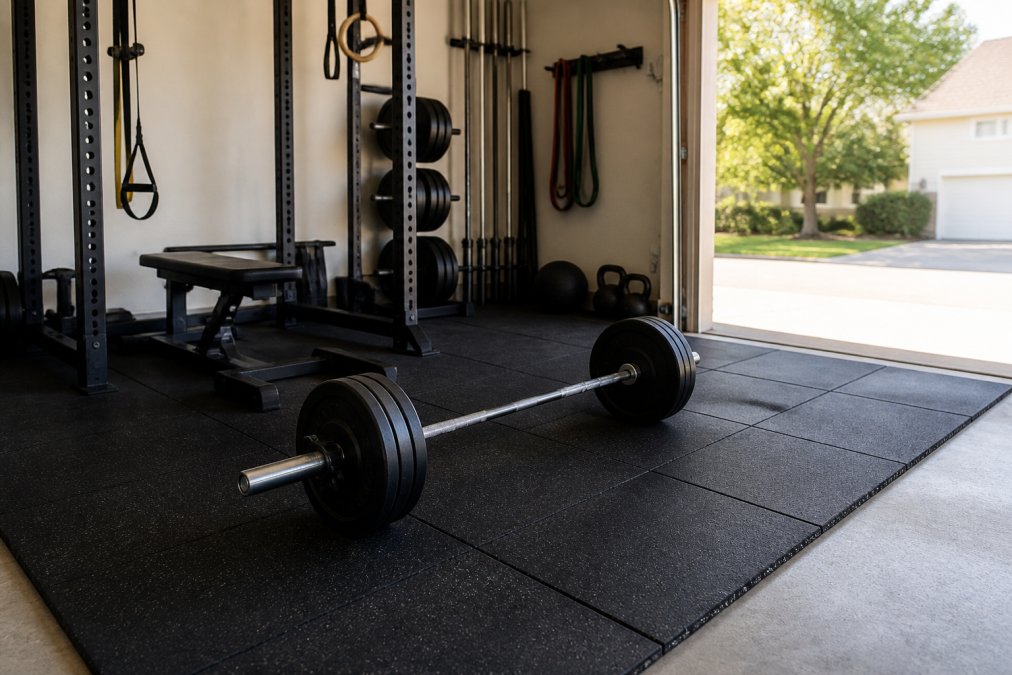
The best garage gym flooring options are interlocking rubber tiles or rolled rubber mats at least 8mm thick, laid over a vapor barrier on sealed concrete. The right floor absorbs dropped barbells, protects the slab from cracking, and keeps plates from sliding during heavy pulls. But the slab underneath and how you isolate it from ground moisture decide whether the floor survives a decade of deadlifts.

Start with the slab, not the mat
Most residential garage slabs are poured 4 to 6 inches thick on a compacted base, often with welded wire mesh or fiber reinforcement rather than rebar. That is adequate for a parked car and a loaded rack, but not for repeated point-load impacts from a dropped barbell. Before you buy matting, check three things:
- Thickness and reinforcement. A 4-inch unreinforced slab is the most vulnerable. Measure the slab edge at the garage door. If it is 4 inches and you plan to drop loaded barbells from overhead, plan on a dedicated lifting platform rather than mats alone.
- Control joints and cracks. Hairline shrinkage cracks are normal. Cracks wider than a credit card, or cracks with vertical displacement on either side, indicate movement that matting will hide but not fix.
- Efflorescence and staining. White chalky deposits or dark moisture rings mean the slab is wicking groundwater. That is a vapor-barrier problem, not a flooring problem, and it will rust steel from the bottom up if covered without addressing it.
Match the flooring to the lift
The right spec depends on what you drop and from how high:
| Lift type | Typical drop height | Flooring recommendation |
|---|---|---|
| Squats, bench, overhead press (controlled) | Rack height, guided | 8mm rolled rubber under the rack footprint |
| Deadlifts and Olympic lifts (uncontrolled) | Waist to overhead | 15mm+ rolled rubber over a plywood-and-rubber platform |
| Dumbbell and kettlebell work | Waist height | 6-8mm interlocking tiles |
| Cardio and bodyweight zones | None | 4-6mm tiles or bare sealed slab |
For a dedicated deadlift or Olympic zone, the standard build is a 3/4-inch plywood base layer topped with rubber, with the bar landing on rubber and the lifter standing on plywood or a center platform insert. This spreads impact across a wider area than mats alone and protects both the bar and the slab.
Vapor barrier and moisture control
Garage slabs wick moisture from the soil beneath them year-round, and the rate rises in humid months. Moisture trapped under rubber promotes mold, degrades mat backing, and rusts steel frames and plate inserts from the bottom up. Two practical approaches:
- Rolled vapor barrier under loose-lay mats. A 6-mil polyethylene sheet under rolled rubber is the cheapest fix. Overlap seams by 6 inches and tape them.
- Sealed slab plus breathable edges. If you seal the concrete with a penetrating sealer, leave a small gap at the mat perimeter so any residual moisture can escape rather than being trapped.
Avoid gluing mats to an unsealed slab. Adhesive traps moisture against the concrete and makes the floor impossible to lift for inspection or reconfiguration.
Quick decision path
- Measure slab thickness at the door edge.
- Identify your heaviest uncontrolled drop (deadlift, clean, snatch).
- If the slab is 4 inches and unreinforced, add a plywood-and-rubber platform under the drop zone.
- Lay a taped vapor barrier before any loose-lay matting.
- Keep racks and plate storage on the mat, not on bare concrete, to prevent sliding and surface abrasion.
Power Racks and Squat Stands Built for Garage Conditions
A garage-grade power rack is defined by three things: steel gauge, finish, and stability under load. Look for frames built from 11- or 12-gauge steel with a powder-coated finish, and check the weight capacity rating before buying.

The Commercial Squat Rack with Safety Bars, J-Hooks & Weight Storage at $1,499 is a solid benchmark. It ships with a 7 ft Olympic barbell, integrated plate storage, and adjustable J-hooks and safety catches for confident solo training. The integrated storage keeps plates off the floor, which matters when square footage is limited.
Powder-coated steel resists the corrosion humidity causes in non-climate-controlled spaces. Knurling and tensile strength matter, but the coating determines whether the rack still looks and functions like new after three winters.
Smith Machines and All-in-One Systems for Small Footprints
All-in-one systems solve the small-footprint problem by combining a Smith machine, functional trainer, and power rack into one vertical unit. For garages under 200 square feet, this consolidation is often the difference between a usable gym and a cluttered one.
The All-in-One Home Gym, Power Rack w/ Smith Machine & Functional Trainer at $3,499 is the most space-efficient option here. It bundles dual 220 lb weight stacks, a Smith machine for guided barbell work, a functional trainer pulley system, and accessories including a 7 ft Olympic bar, safety bars, J-hooks, and lat bar.
If you prefer a dedicated Smith machine without the rack, the SFE Commercial Smith Machine at $2,499 uses counter-balanced weights and a heavy-duty steel frame with a 584 lb net weight. For cable and accessory work specifically, the Selectorized All-in-One Functional Trainer at $2,999 offers dual 250 lb stacks with a 2:1 pull ratio and a compact footprint.

How to Build a Home Gym on Budget Without Sacrificing Durability
The smartest way to build a home gym on budget is to buy fewer, heavier-duty pieces instead of many cheap ones. One commercial-grade rack that lasts 15 years costs less per year than three budget racks that fail in five.
Prioritize in this order:
- Flooring first. Rubber matting protects everything above it and costs a fraction of replacing a cracked slab.
- One anchor piece. A power rack or all-in-one system covers squats, presses, and pulls. The Commercial Squat Rack at $1,499 is the lowest-cost entry into commercial-grade steel.
- Adjustable dumbbells over fixed sets. They replace an entire rack and free up floor space.
- Add cardio last. A Curved Air Runner Elite Pro at $2,199 is self-powered, so it needs no outlet and no subscription.
Buying used commercial equipment is a legitimate budget lever, but inspect welds, check for rust at the base, and confirm the frame is straight before committing.
Maintaining Home Gym Equipment in Non-Climate-Controlled Spaces
Maintaining home gym equipment in a garage comes down to managing moisture, temperature swings, and dust. Corrosion resistance is the biggest factor in how long gear lasts in a space with humid summers and freezing winters. The difference between gear that survives ten years and gear that pits in two is not brand loyalty, it is the materials and coatings on the frame, fasteners, and weight plates.
Why garages rust steel faster than any other room
Steel frames rust from condensation, not rain. When warm, humid air hits cold steel in a spring thaw, moisture beads on the surface (energy.gov). This cycle repeats every time the garage warms and cools, pushing moisture into scratches, weld seams, and bolt holes where coatings are thinnest. A climate-controlled gym never sees this cycle; a garage sees it dozens of times a year.
The result: a rack that looks fine in a showroom can show surface rust at the base and around bolt heads within two seasons if the coating and hardware are not chosen for the environment.
Coating and material hierarchy for garage conditions
Not all finishes resist moisture equally. From most to least durable in a garage setting:
- Powder coat over properly prepped steel. A cured powder coat is thicker and more chip-resistant than liquid paint and resists moisture well as long as it is not scratched through (Paint Standards and Related Coating Standards - Standards Products - Standards &...). This is the baseline for garage-grade equipment.
- Zinc-rich primer under powder coat. The zinc sacrifices itself at scratches, slowing rust creep. This is the coating spec that separates commercial-grade racks from budget ones.
- Zinc-plated or stainless fasteners. Bolts, J-hooks, and safety pins are the first parts to rust because coatings are thin at threads. Stainless or zinc-plated hardware is worth the small upcharge.
- Chrome plating on bars. Chrome looks premium but flakes at knurl edges and stress points, and exposed steel rusts quickly. For a garage, a bar with a bare steel or black oxide shaft and a durable sleeve finish holds up better than decorative chrome.
- Rubber- or urethane-coated plates. The coating protects the plate and floor, but the steel insert is the weak point. If moisture reaches it, it rusts from the inside.
A maintenance routine that matches the environment
What works in practice:
- Wipe frames down monthly with a dry cloth to remove dust that traps moisture against the coating.
- Touch up scratches in the powder coat immediately with matching paint. A scratch left open for a season becomes a rust bloom.
- Run a dehumidifier or a small fan to keep air moving and dry condensation before it pools.
- Store plates off the floor on a rack rather than leaning them against walls, so air circulates around the inserts.
- Lubricate cable pulleys and guide rods every few months with a light machine oil, not grease, which attracts dust.
- Inspect bolt heads and weld seams quarterly. These are where rust starts first and where a touch-up prevents a structural problem.
A Commercial Dumbbell Rack at $999 keeps 15 pairs off the floor and away from ground moisture, which extends both the dumbbells and the floor.
Seasonal checklist
- Spring thaw: Check for condensation on cold steel. Wipe down and run a fan.
- Summer humidity: Run the dehumidifier, and check plate inserts for rust smell.
- Fall temperature swings: Touch up any coating scratches before winter.
- Winter freeze: Keep the space above freezing if possible. Repeated freeze-thaw cycles stress both the slab and the coatings.
Conclusion: Building a Garage Gym That Lasts
The gap between a garage gym that lasts and one that doesn't comes down to three choices: flooring, steel gauge, and moisture control. Get those right and the rest follows.
Perfected Health Co. carries commercial-grade equipment built for exactly this environment, from all-in-one power racks to squat stands with integrated weight storage. Free shipping on most orders within the continental U.S. and a 30-day return policy mean you can commit to a setup without the risk. See the full setup and build a training space that holds up for the long haul.
Frequently Asked Questions
What is the best equipment for a home garage gym?
The best garage gym equipment depends on your training goals and available space. A power rack or squat stand anchors most setups, paired with an Olympic barbell and bumper plates. Adjustable dumbbells cover accessory work without taking up floor space. For cardio, a curved air runner or stepmill adds conditioning without a power cord. All-in-one systems that combine a Smith machine, functional trainer, and power rack work well when square footage is limited because they consolidate multiple stations into one footprint.
Will my gym equipment rust in my garage?
Garage humidity and temperature swings can cause surface rust on steel equipment over time, especially in regions with damp summers or cold winters. Equipment with powder-coated steel frames and corrosion-resistant hardware holds up better than bare metal. To reduce risk, keep equipment off bare concrete, run a dehumidifier, and wipe down frames and guide rods monthly. Storing weight plates on racks rather than the floor also limits moisture contact.
What are the must-haves for a garage gym?
Start with a power rack or squat stand with safety bars and a set of bumper plates. Add an adjustable bench for pressing and accessory work. Rubber matting protects your garage floor and reduces noise. A dumbbell rack keeps weights organized and off the floor. If space allows, a functional trainer or cable pulley system expands your exercise range. Cardio equipment like a curved treadmill or stepmill rounds out conditioning work.
How do I protect my garage gym equipment from humidity?
Run a dehumidifier set between 40% and 50% relative humidity to keep moisture levels consistent. Place rubber matting under all equipment to create a barrier between steel and concrete, which wicks moisture. Apply a light coat of silicone spray or machine oil to guide rods and exposed metal surfaces every few months. If your garage has windows, keep them sealed during humid months. A simple hygrometer costs under $20 and lets you monitor conditions before rust becomes a problem.
How much does it cost to build a durable garage gym?
A functional garage gym starts with a squat rack around $1,499 and a commercial Smith machine at $2,499 if you want guided barbell training. All-in-one systems with a power rack, Smith machine, and functional trainer run $3,499 and replace three separate stations. Budget another $200 to $500 for rubber flooring and $100 to $300 for a dehumidifier. Buying durable equipment upfront costs more than budget alternatives but avoids replacement costs within a year or two.