


Cold Plunge vs Sauna: Best Recovery Comparison for 2026
Table of Contents
- Cold Plunge vs Sauna: Quick Comparison Table
- Cold Plunge vs Sauna for Muscle Recovery
- How Long to Stay in a Cold Plunge
- Contrast Therapy Benefits for Athletes
- Home Installation Logistics: What to Know Before You Buy
- Budget vs Luxury: Which Recovery Setup Fits Your Home Gym
- Frequently Asked Questions
Last Updated: September 17, 2026
Cold Plunge vs Sauna: Quick Comparison Table
Cold plunge vs sauna is not an either/or decision for most serious lifters. Cold immersion targets acute inflammation and CNS recovery; sauna drives blood flow and parasympathetic downregulation. The right pick depends on your training phase, home layout, and budget.

At Perfected Health Co., we build home recovery setups for strength athletes, and the question we field most is whether a plunge or a sauna earns its floor space first.
| Factor | Cold Plunge | Sauna |
|---|---|---|
| Primary effect | Vasoconstriction, reduced systemic inflammation | Vasodilation, increased blood flow |
| Best timing | Post-training, hard sessions | Post-training or evening wind-down |
| Session length | 2-10 minutes | 15-30 minutes |
| Temperature range | 37-59°F | 140-194°F |
| Space needed | 3-4 sq ft footprint | 16-30 sq ft footprint |
| Power | Standard 120V outlet | Varies by heater type |
| Best for | Acute soreness, CNS reset | Stress resilience, sleep, circulation |
Cold Plunge vs Sauna for Muscle Recovery
Cold water wins the acute recovery battle. Immersion triggers vasoconstriction, reducing blood flow to inflamed tissue and blunting delayed onset muscle soreness in the 24-48 hours after a hard session. Many athletes find a 10-minute plunge at 50-55°F meaningfully reduces next-day stiffness.
How Long to Stay in a Cold Plunge
Therapeutic cold immersion runs 2-10 minutes at 45-59°F. Beginners should start at 2-3 minutes and build tolerance over several weeks; near 39°F, 2-5 minutes is the standard window.
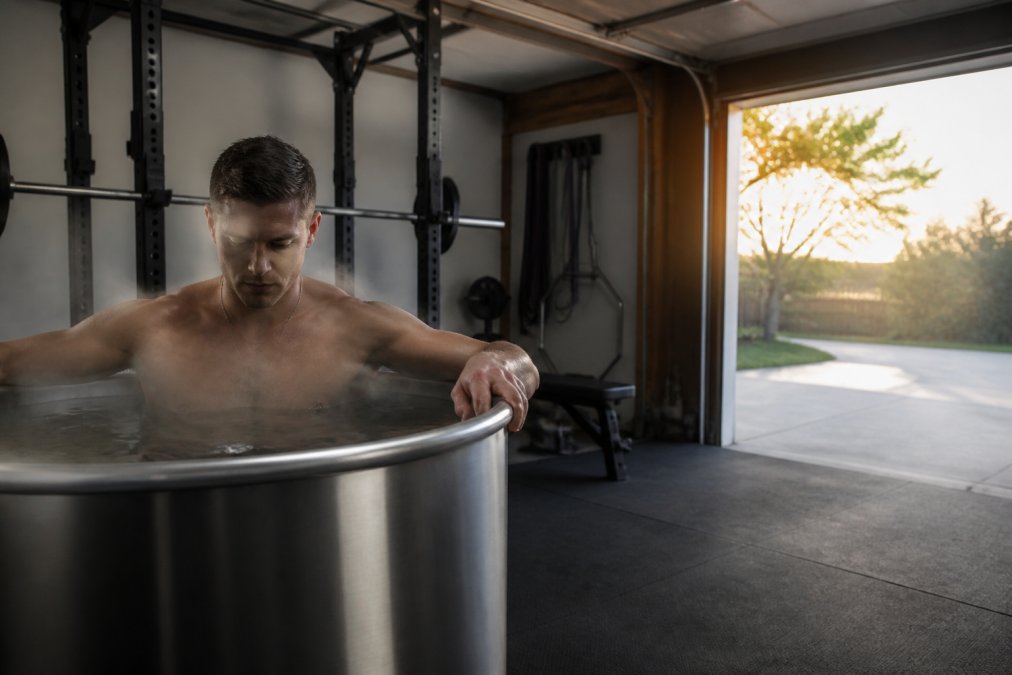
Contrast Therapy Benefits for Athletes
Contrast therapy, alternating hot and cold, stacks both stimuli into one session. The shift between vasodilation and vasoconstriction creates a pumping effect on peripheral blood flow, and many athletes report faster perceived recovery than either modality alone. Heat opens vessels and drives nutrient delivery; cold closes them and pushes metabolic waste out; repeating the cycle moves more blood through working muscles than either temperature held steady.
A Practical Contrast Protocol
A common pattern most practitioners land on after a few weeks of trial and error:
- Warm-up round: 10-15 minutes in the sauna at 160-180°F to raise core temperature and start sweating.
- Cold round: 1-3 minutes in the plunge at 50-59°F. Beginners should start at 1 minute and add 30 seconds per session.
- Repeat: 2-4 total rounds, keeping the sauna round longer than the cold round.
- Finish cold: end on the plunge, not the sauna.
Timing Rules That Actually Matter
Order and spacing change the adaptation you get:
- After strength training: keep contrast work at least 4-6 hours away from the lift if muscle growth is the goal. Cold immediately post-lift can blunt the inflammatory signaling that drives hypertrophy.
- After conditioning or sport: contrast work 30-60 minutes post-session is fine and is where most athletes get the biggest perceived recovery benefit.
- On rest days: contrast work in the morning or early afternoon, not within 2 hours of bed, because the cold finish is alerting.
- Before competition: a short contrast block 2-3 hours out can leave you feeling loose, but skip it within 60 minutes of warm-up.
Equipment That Handles Both Temperatures
Home Installation Logistics: What to Know Before You Buy
Measure your clearance before you measure your budget. The biggest mistake buyers make is ordering a unit that will not fit through the door or into the planned corner. Four things decide whether a unit works in your space: delivery path, electrical capacity, floor load, and water and drainage access.
1. Delivery Path and Footprint
A cold plunge needs a level surface and roughly 3-4 square feet. The Kooru Cold Plunge Tub requires at least 33 inches of clearance through doors or passages, so measure your narrowest doorway, stairwell turn, and hallway corner before ordering. A 2-person sauna cabin typically occupies 16-30 square feet and needs at least 6 feet 6 inches of ceiling height, plus door-swing and bench-overhang clearance.

2. Electrical Capacity
This is where most home buyers get surprised. Cold plunges with a chiller typically run on a standard 120V grounded outlet at 350-500 watts, which most household circuits handle without modification. GFCI protection is required by code in garages, basements, bathrooms, and any outdoor location.
3. Floor Load and Structural Support
Water is heavy. A 100-gallon plunge tub weighs roughly 800 pounds filled, plus the tub and the person in it. That load is concentrated on a small footprint, so a standard residential floor handles it, but a second-story room, deck, or post-tension slab garage may need review. Saunas are lighter per square foot but still add several hundred pounds with the heater and stones.
4. Water, Drainage, and Maintenance
A plunge needs a fill source and a drain path. Most home users fill with a garden hose and drain to a floor drain, utility sink, or exterior grade; if neither is available, plan on a submersible pump and hose run. Budget for filter changes and water chemistry: most chillers use a cartridge or pleated filter that needs rinsing every 1-2 weeks and replacement every 1-3 months, plus a sanitizer routine.
Pre-Purchase Checklist
- Door and hallway clearance measured at the tightest point
- Circuit amperage confirmed against the unit's spec sheet
- GFCI protection in place for any wet-location outlet
- Floor load reviewed for upper floors, decks, and post-tension slabs
- Fill source and drain path identified
- Ventilation planned for any indoor sauna
- Maintenance schedule and filter replacement cost estimated
Budget vs Luxury: Which Recovery Setup Fits Your Home Gym
| Setup | Price | Best For |
|---|---|---|
| Plunge Pod Cold Plunge Tub | $4,390 | First plunge, small footprint |
| Plunge All-In Gen 2 | $7,990 | Contrast therapy in one unit |
| Kooru Cold Plunge Tub | $7,999 | Handcrafted redwood aesthetic |
| The Sauna | $11,040 | Infrared, indoor or outdoor |
| SaunaLife Model G6 | $26,890 | Traditional Finnish, 2-4 people |
Here's what actually decides it for most home gyms: if you can only fund one unit this year, buy the one that solves your worst recovery problem. Soreness after heavy squats points to cold; broken sleep and chronic stress point to heat. Plenty of athletes eventually run both.
Frequently Asked Questions
Which is better for muscle recovery: cold plunge or sauna?
Cold plunge wins for acute muscle recovery. Cold water immersion constricts blood vessels, reduces swelling, and slows inflammation after heavy lifting. Research on delayed onset muscle soreness shows cold immersion can cut soreness and speed strength recovery. Sauna helps more with blood flow, relaxation, and cardiovascular adaptation over time. Many athletes use both: cold plunge right after training for inflammation control, sauna on rest days for circulation and stress resilience.
Can you use a cold plunge and sauna in the same session?
Yes, this is contrast therapy. The standard protocol: 15-20 minutes in the sauna, then 2-3 minutes in the cold plunge, repeating for 2-3 rounds. Always end with cold. The heat opens blood vessels (vasodilation), the cold constricts them (vasoconstriction), and the cycle flushes metabolic waste while training your nervous system. If you are new to contrast therapy, start with one round and build up. The Plunge All-In Gen 2 handles both temperatures in one unit, reaching 37°F and 104°F.
How long should you stay in a cold plunge for recovery?
Most recovery protocols call for 2-5 minutes at 50-59°F, or 1-3 minutes at 39-45°F. The Plunge Pod reaches 39°F in about 20 minutes of setup, so you can hit therapeutic temps fast. Beginners should start at 60°F for 1-2 minutes and work down. Longer is not better: 10-15 minutes offers no extra recovery benefit and raises hypothermia risk. Track how you feel 24 hours later and adjust duration, not temperature, first.
What are the primary contrast therapy benefits for athletes?
Contrast therapy combines heat and cold to boost blood flow, reduce systemic inflammation, and accelerate muscle recovery. Alternating sauna and cold plunge triggers vasodilation and vasoconstriction, which pumps fresh blood through tired muscles and clears metabolic byproducts. Athletes report less soreness, better sleep quality, and improved stress resilience. The cardiovascular adaptation is similar to moderate cardio: heart rate climbs in heat, drops in cold, training your parasympathetic and sympathetic nervous systems.
Is it better to do a cold plunge before or after a sauna session?
Sauna first, cold plunge second. Heat raises your core temperature and opens blood vessels; cold then constricts them and triggers norepinephrine release. Ending on cold also helps you cool down faster and leaves you alert rather than drained. The exception: if your goal is relaxation and sleep, end on heat. For recovery and performance, always finish cold. Wait 10-15 minutes between a workout and a sauna session to let your heart rate settle.