


Best Space Saving Smith Machine 2026: Top Home Gym Picks
Table of Contents
- What to Look for in a Space Saving Smith Machine
- All-in-One Functional Trainer with Smith Machine: The Compact Home Gym Setup
- Smith Machine Safety Features for Solo Lifters
- Smith Machine vs Power Rack for Small Spaces
- Weight Capacity, Stability, and Structural Integrity
- Noise Reduction and Vertical Storage for Apartments and Garages
- Assembly Time, Attachments, and Ergonomics
- Conclusion
- Frequently Asked Questions
Last Updated: September 11, 2026
What to Look for in a Space Saving Smith Machine
A space saving smith machine is a guided-barbell strength system that delivers pressing, squatting, and pulling inside a footprint small enough for a garage bay, spare bedroom, or converted corner. Buyers now expect commercial-grade rails, real weight capacity, and cable integration in packages that once required an entire room.
This guide from Perfected Health Co. breaks down the specs that decide whether a compact unit works in your space: footprint, ceiling height, bar path, safety hardware, and movement under load.
The biggest mistake buyers make is measuring floor space and ignoring vertical travel: a machine can fit on paper yet be unusable because the bar cannot clear your overhead press lockout.
Footprint, Ceiling Height, and Vertical Travel
Floor footprint is the number everyone checks. Ceiling height is the number that ruins the purchase.
Most compact Smith machines occupy roughly the same floor area as a mid-size power rack, but their fixed-rail carriage demands more headroom. Measure three things:

- Standing height plus reach at full overhead extension
- Carriage travel at the top of the rail, not the frame height
- Pull-up bar clearance if the unit includes one
A practical rule: add your standing reach to the machine's stated top rail position and confirm clearance above it. If you are within a few inches, look for a lower top-rail spec.
Bar Path Mechanics: Linear Bearing vs Counterbalanced Bar
Two mechanisms dominate the category and change how the machine feels more than any other spec.
Linear bearing systems run the carriage on bearing trucks inside fixed steel rails: rigidly vertical, low friction, identical tracking every rep.
Counterbalanced bar systems offset part of the carriage weight, so the empty bar feels lighter than its true weight. Beginners like the reduced starting load; experienced lifters dislike that it masks the real load and changes the eccentric feel.
What most guides miss: rail rigidity matters more than mechanism. A stiff linear bearing rail with a heavy frame outlasts a lighter counterbalanced unit every time, even if the counterbalanced version feels smoother in the showroom.
All-in-One Functional Trainer with Smith Machine: The Compact Home Gym Setup
An all-in-one functional trainer with smith machine combines three stations, a Smith machine, a cable pulley system, and a power rack or pull-up structure, into one frame. For a compact home gym, this is the highest-value configuration available because it replaces three separate footprints with one.

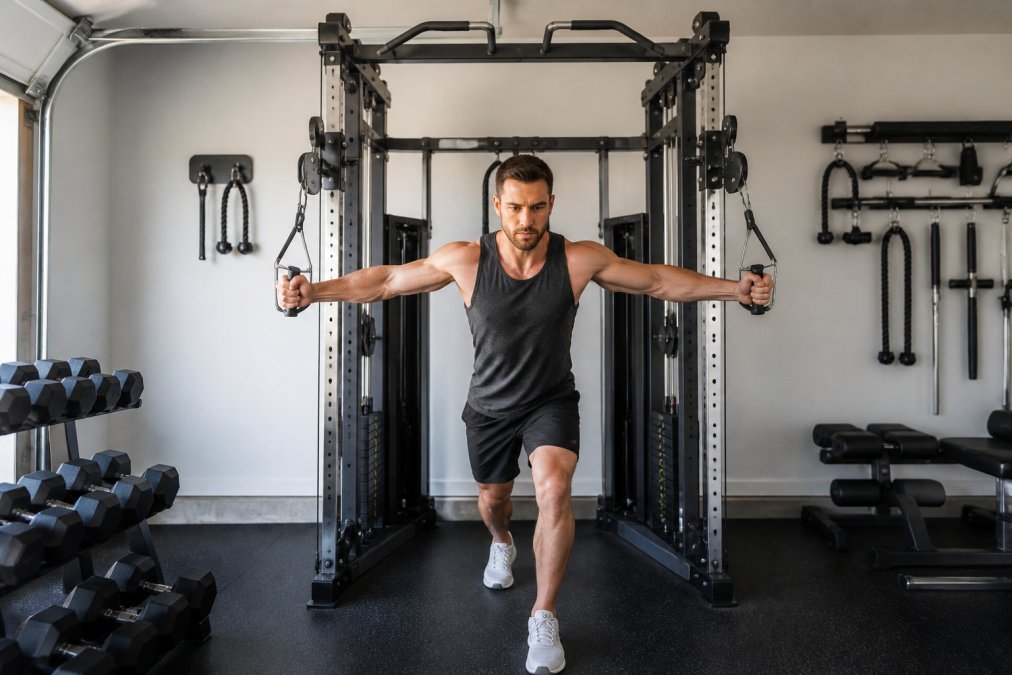
Three dedicated machines need three floor zones plus walking clearance; a single all-in-one needs one. In a one-car garage bay, that decides whether you can still park a car.
Perfected Health Co. stocks an All-in-One Home Gym, Power Rack with Smith Machine and Functional Trainer built around dual 220 lb selectorized weight stacks, which eliminate the separate plate tree and loose plates on the floor. Pin the weight, train, move on.
For more resistance range, the Selectorized All-in-One Functional Trainer Home Gym with dual 250 lb stacks uses a 2:1 pull ratio for smooth cable travel across pressing, rowing, and pulling.
Is an all-in-one worth it over separate machines?
Yes, when floor space is your binding constraint. An all-in-one costs more than a single dedicated Smith machine but less than buying a Smith machine, functional trainer, and rack separately, and it uses a fraction of the floor area. The trade-off: you cannot upgrade one station independently later.
Smith Machine Safety Features for Solo Lifters
Smith machine safety features for solo lifters come down to one question: if a rep fails, does the bar stop? On a free barbell, a failed bench press is an emergency; on a properly equipped Smith machine, it is a minor inconvenience.
Look for these, in this order of importance:
- Safety catches or lockout hooks spaced closely enough that the gap between positions is small
- Multiple catch heights, so the safeties work for bench, squat, and overhead press without compromise
- A reliable rotation or hook mechanism that engages without requiring you to fight the bar
- Reinforced catch hardware, since this is the component taking a dropped load
Smith Machine vs Power Rack for Small Spaces
A power rack gives you a free bar path and unlimited movement variety. A Smith machine gives you a fixed path, built-in safety, and often cable integration in the same footprint. In a small space, the deciding factor is usually ceiling height and depth, not preference.
Here is the honest comparison most reviews skip:
| Factor | Smith Machine | Power Rack |
|---|---|---|
| Bar path | Fixed, guided | Free, requires control |
| Spotter needed | No | Yes, for heavy bench |
| Cable integration | Common in all-in-one units | Rare, needs add-ons |
| Ceiling demand | Higher, due to rail travel | Lower |
| Solo safety | Built-in catches | Requires correctly set pins |
| Space efficiency | Higher when cables included | Lower if adding machines |
If you train alone and press heavy, the Smith machine wins on safety. If you compete in powerlifting and need free-bar specificity, the rack wins on carryover, accept the extra footprint or find a folding rack.
Weight Capacity, Stability, and Structural Integrity
Weight capacity is a marketing number until you check frame gauge and anchoring. A machine rated for heavy loads on thin tubing will flex, and flex in a guided rail system shows up as a binding carriage and uneven bar travel.
Three specs predict long-term stability:
- Frame gauge and tube dimensions. Thicker steel resists flex under load.
- Rail mounting. Rails bolted to a braced frame hold alignment; rails mounted to a single upright do not.
- Anchoring provision. Floor or wall anchoring points stop the unit from walking during fast reps.
Stability also depends on the base: a wide stance with cross-bracing resists lateral sway during cable work, where single-column units feel worst. For heavy rows or woodchops, base width matters as much as the Smith rail spec.
Noise Reduction and Vertical Storage for Apartments and Garages
Noise is the spec nobody lists and everybody regrets ignoring, and the most common reason a compact Smith machine gets sold secondhand by an apartment lifter within a year. Two sources dominate: the carriage rolling on the rails, and the weight stacks or plates settling at the bottom of a rep.
Where the noise actually comes from
- Carriage on rails. Bushing-guided carriages rumble and grind as bushings wear. Bearing-guided carriages (sealed linear bearings or cam followers) stay quieter for years because rolling contact does not scrape.
- Stack impact. Selectorized stacks slam the bottom plate against the base on every rep; rubber-damped stack bases and urethane bumper pucks absorb that hit. Loose steel plates on a steel horn rattle on every eccentric.
- Frame resonance. A thin-wall frame transmits vibration into the floor like a drum; thicker tube and cross-bracing deaden it.
- Bar rattle in the hooks. A loose hook-to-bar fit clanks on rerack. Look for urethane-coated J-hooks or a snug rotation mechanism.
Dampening that actually works in a shared building
A common pattern among apartment lifters is a three-layer floor build: a rubber horse-stall mat or 3/4-inch rubber tile under the machine, closed-cell foam or cork underneath, and a plywood sub-panel between the two to spread point loads. This is the same approach used under commercial treadmills in multi-story buildings, and it addresses both airborne noise (what your neighbor hears) and structure-borne vibration (what they feel). Mats alone fix the first and barely touch the second.
Also worth doing:
- Anchor the machine to the sub-panel, not directly to a shared concrete slab, so vibration crosses a dampening layer before reaching the structure.
- Keep the machine off exterior walls and off walls shared with a bedroom or neighbor's living room.
- Use bumper plates if you load plates manually; steel plates on a Smith are the loudest configuration in the category.
- Train during posted quiet hours. Most leases and HOA rules set them, and a Smith machine is not quiet regardless of dampening (hud.gov).
Vertical storage: use the frame, not the floor
Most guides stop at floor footprint. The real lever in a tight room is vertical storage: the machine's own frame is free real estate you already paid for.
- Weight plate storage horns. A vertical plate tree or wall-mounted horn rack keeps plates off the floor and doubles as ballast against tipping. Mount it behind the machine, not beside it, so it does not eat walking clearance.
- Attachment hooks on the uprights. Hang handles, ropes, ankle straps, and collars at chest height so you can grab and re-rack without bending, and nothing sits below knee level as a trip hazard.
- Band and strap storage on the pull-up bar zone. Bands coil over the crossmember or hang from a single hook, using dead space on most machines.
- A narrow wall rack for accessories. A 12- to 18-inch-deep wall rack for belts, wraps, and a foam roller keeps the floor clear without adding a footprint.
- Under-machine storage. The gap under the base is often wasted; a low-profile tray for a landmine, row handle, and jump rope fits in most all-in-one frames.
That sounds trivial. It is not. Floor clutter makes a small gym feel unusable, and every item you move off the floor buys back training space, and the willingness to actually train in the room.
Measure your wall space before you buy storage. A vertical plate tree needs roughly 12 inches of depth and 4 feet of height, and it needs to sit where you will not swing a cable handle into it. Storage that blocks a movement pattern is worse than no storage.
Assembly Time, Attachments, and Ergonomics
Real-world assembly time for an all-in-one Smith machine is the number manufacturers get wrong most often. Published estimates assume two people, power tools, a clear floor, and no interruptions. Plan for a full day and recruit help for the upright and stack assembly, the heaviest phase.
Realistic man-hour estimates
A common pattern for a full all-in-one with dual selectorized stacks:
- Unboxing and inventory. 30 to 60 minutes. Count every bolt bag against the parts list first; missing hardware is the biggest cause of a stalled build.
- Base frame and uprights. 1.5 to 2.5 hours with two people. Uprights are tall and awkward; one person cannot safely hold and bolt them.
- Smith rail and carriage install. 1 to 2 hours. Alignment-critical: rails must be parallel and square or the carriage will bind.
- Cable and pulley routing. 1 to 2 hours. The most error-prone phase. Route cables before tightening the frame and test travel before closing the pulleys.
- Weight stacks and guide rods. 1 to 1.5 hours. Stacks are heavy and must be loaded in order; two people minimum.
- Attachments, pads, and final torque. 30 to 60 minutes. Re-check every bolt after the first session; frames settle.
Solo assembly roughly doubles the time and is unsafe for the upright and stack phases. Budget 6 to 10 man-hours for a two-person build; treat anything under 4 hours as marketing (acefitness.org).
Ceiling height: the spec that kills the purchase
Low ceilings are the most common reason a compact Smith machine gets returned: the carriage travels to the top of the rail, and the rail sits above the frame's stated height. Before buying:
- Measure your standing reach (fingertips overhead, shoes on).
- Add the machine's top rail position, not the frame height, they differ, often by several inches.
- Add pull-up bar clearance if the unit has one; a pull-up bar adds 8 to 12 inches above the frame on most all-in-one units.
- Confirm clearance above that total for an overhead press lockout, plus a few inches of margin.
A practical rule: if your standing reach plus the top rail position leaves less than 6 inches of headroom, look for a lower top-rail spec (acefitness.org). A machine that fits your room on paper but cannot clear your overhead press lockout is still the wrong machine.
Attachment compatibility
Attachment compatibility decides how versatile the machine stays over time. Confirm it accepts:
- Standard cable handles, ropes, and bars (most use a 1-inch or 25mm cable end, but verify)
- A landmine or row attachment if you want free-weight patterns
- A leg developer or preacher pad if those movements matter to you
- Replacement or additional attachments from the same manufacturer, since third-party fit is inconsistent
Ergonomics
Check the cable pulleys at their lowest and highest settings, the pull-up bar width, and whether the Smith bar sits at a comfortable starting height for your bench setup. A machine that fits your room but not your body is still the wrong machine.
Conclusion
The hard part of buying a space saving smith machine is not finding one, it is finding one whose vertical travel, rail rigidity, and safety catch spacing all match your room and your training. Get those three right and the machine disappears into your routine.
Perfected Health Co. builds its catalog around that idea: durable, thoughtfully engineered strength and recovery equipment for lifters who train at home, backed by free shipping on most orders and a 30-day return policy. Our all-in-one systems pair a Smith machine, functional trainer, and power rack with dual selectorized weight stacks, so one footprint covers your entire session. See the full setup and build a training space you will actually use.
Frequently Asked Questions
How much floor space do I need for a home Smith machine?
Most compact Smith machines need about 4 by 4 feet of floor space, but an all-in-one functional trainer with Smith machine can run closer to 6 by 4 feet. Measure your ceiling height too, since vertical travel on many units requires 7 to 8 feet of clearance. Leave 2 feet on each side for loading plates and moving around the bar.
Are vertical or angled Smith machines better for small home gyms?
Vertical bar paths take up less depth, which helps in tight garages and spare rooms. Angled paths feel more like a free-weight press and can be easier on the shoulders, but they often need more front-to-back room. For a compact footprint, a vertical or counterbalanced bar usually fits better without sacrificing a smooth glide.
Can you get a full-body workout with a compact Smith machine?
Yes. A space saving smith machine with an integrated cable pulley system and functional trainer handles chest, back, legs, shoulders, and arms. Add a bench and a few attachments, and you can train every major muscle group. Many lifters pair the Smith bar for heavy presses with cables for rows, curls, and face pulls.
What safety features matter most for solo lifters on a Smith machine?
Look for safety catches or a safety lockout that lets you rack the bar at any height, plus a counterbalanced bar that stays put when you let go. A smooth glide and sturdy frame gauge also matter. These features let you train heavy alone without a spotter, which is a key reason solo lifters choose a Smith machine over a power rack.